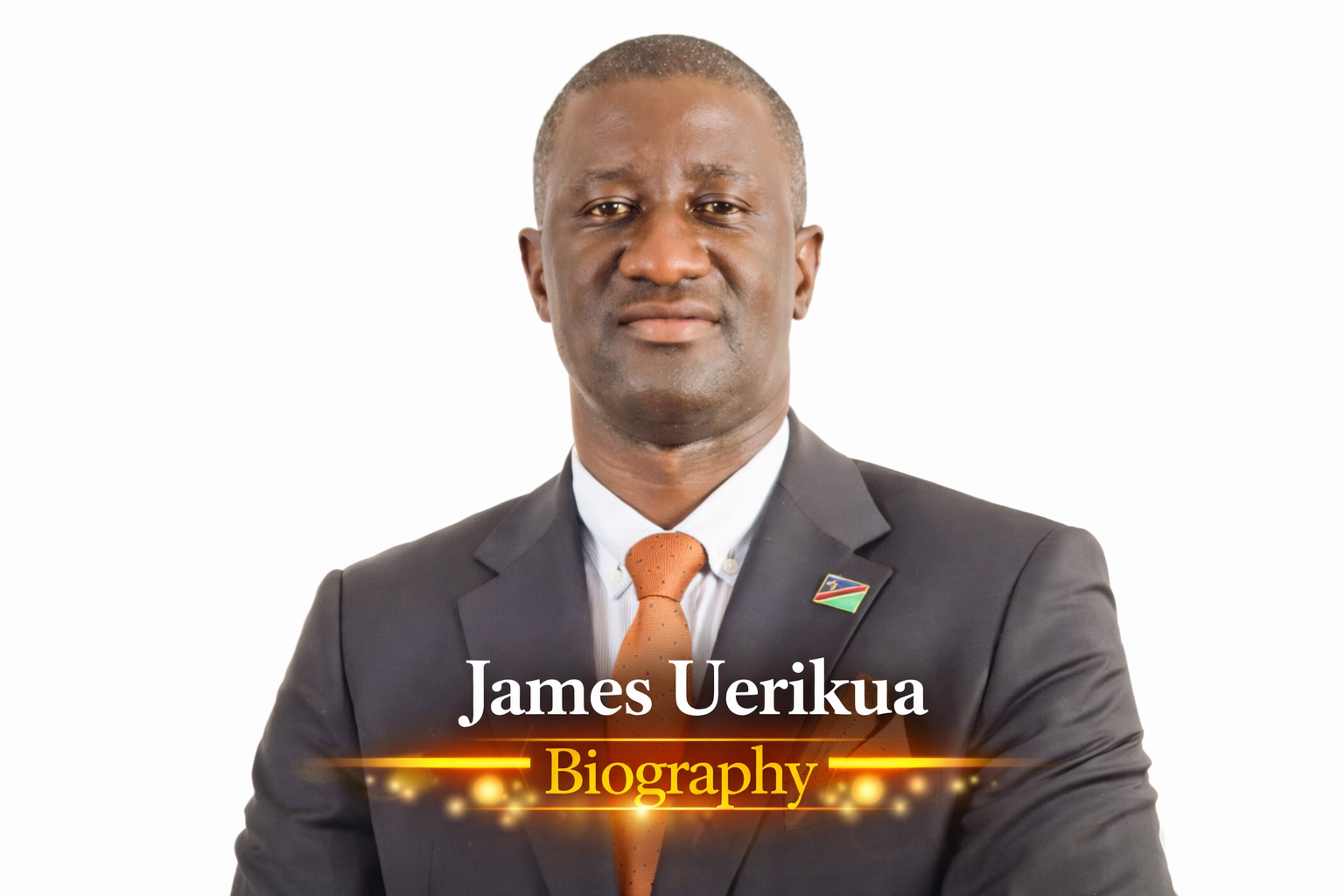
Who Was James Uerikua?
James Unomasa Uerikua was a Namibian politician, development planner, and public servant known for his significant contributions to regional and national governance. Born on August 2, 1982, he built a respected career within Namibia’s public sector, rising through key roles in government institutions before serving as the Governor of the Otjozondjupa Region from 2020 to 2025. He later became a Member of Parliament in 2025 and chaired the Parliamentary Committee on International Relations, Defence and Security, positioning him as an influential voice in national policy and development.
He gained recognition for his strong background in development planning, agriculture, and governance, with a career that spanned multiple ministries and high-level government offices. His leadership was marked by a focus on community development, land reform, and regional growth, earning him respect within the SWAPO party and across Namibia’s political landscape.
James Uerikua is currently trending in 2026 due to his tragic death in a road accident, which also claimed the life of his son. The sudden loss has drawn widespread national attention and mourning, highlighting his impact as a dedicated public servant. A key highlight of his career was his transition from technical development roles into top political leadership, reflecting his steady rise and commitment to serving the people of Namibia.
Early Life and Background: James Uerikua Childhood, Family and Origins
James Unomasa Uerikua was born on August 2, 1982, in Namibia, where he was raised within a culturally rich and community-oriented environment. He is strongly associated with the Otjozondjupa Region, particularly areas like Otavi, where he was widely regarded as a “son of the soil,” reflecting his deep roots and connection to the local community.
Growing up in Namibia, Uerikua experienced life within a developing nation shaped by both tradition and transformation. His early years were influenced by the values of hard work, resilience, and community responsibility, which are central to many Namibian cultures. These values played a key role in shaping his personality and future ambitions.
He came from a background that emphasized education, service, and leadership, encouraging him from a young age to contribute meaningfully to society. His upbringing exposed him to the realities of rural and regional life, particularly in areas related to agriculture, land use, and community development. These early experiences would later inspire his career path in development planning and governance.
As a child, he showed a growing interest in leadership and public service, driven by a desire to improve the living conditions of his community. His environment nurtured a sense of purpose and responsibility, pushing him toward roles that would allow him to create impact at both regional and national levels.
Overall, James Uerikua’s early life was shaped by strong cultural values, community connection, and a clear sense of direction, laying the foundation for his future as a respected public servant and political leader in Namibia.
Education: James Uerikua Academic Background and Qualifications
James Unomasa Uerikua’s educational journey reflects a strong commitment to academic excellence, leadership development, and professional growth, which played a crucial role in shaping his career in governance and public service.
He began his higher education at the University of Namibia, where he obtained a National Diploma in Agricultural Science in 2005. This early academic foundation exposed him to key issues in agriculture, land use, and rural development—areas that would later define much of his professional work.
Driven by a desire to expand his knowledge in management and leadership, he went on to earn a Master of Business Administration (MBA) from the Management College of Southern Africa (MANCOSA) in 2017. This qualification equipped him with advanced skills in strategic planning, organizational leadership, and public sector management, enabling him to take on more senior roles in government.
In 2025, he achieved another major academic milestone by obtaining a Master of Laws (LLM) in International Business Law from the University of Cumbria. This degree broadened his expertise in legal frameworks, international relations, and policy development, strengthening his role in national governance and parliamentary responsibilities.
In addition to his formal degrees, Uerikua also completed several professional development programs, including a Middle Management Development Programme (2013) and a specialized course in Indigenous Peoples’ Rights at the University of Pretoria. These programs enhanced his understanding of governance, human rights, and leadership in diverse communities.
Overall, his education provided a well-rounded combination of technical knowledge, managerial skills, and legal expertise, which significantly contributed to his effectiveness as a development planner, regional governor, and national political leader.
Career: James Uerikua Professional Journey and Political Rise
James Unomasa Uerikua built a distinguished career in Namibia’s public service, marked by steady growth, technical expertise, and impactful leadership in governance and development.
Uerikua began his professional journey in 2006 as an Extension Technician at the Ministry of Agriculture, Water and Forestry. In this role, he worked closely with rural communities, supporting agricultural development and providing technical guidance to farmers. These early experiences gave him firsthand insight into the challenges faced by local communities, especially in areas of land use and food security.
Between 2010 and 2012, he served as a Development Planner at the Ministry of Lands and Resettlement. Here, he was involved in planning and implementing policies related to land reform and resettlement, further strengthening his expertise in development planning.
He later joined the Office of the Prime Minister (2012–2014) as a Principal Development Planner, where he contributed to national-level development strategies. His performance and growing reputation led to his appointment as Chief Development Planner at the Office of the Vice-President (2014–2020), a role that placed him at the center of high-level policy coordination and national planning.
A major turning point in his career came in 2020, when he was appointed as the Governor of the Otjozondjupa Region. This role marked his transition from technical planning positions into political leadership. As governor, he was responsible for overseeing regional development, coordinating government programs, and representing the region at the national level.
During his tenure as governor (2020–2025), Uerikua became known for his commitment to community development, land reform, and regional growth initiatives. He worked on improving infrastructure, supporting local economies, and strengthening governance structures within the region.
In 2025, he advanced to the national stage when he became a Member of Parliament in Namibia’s National Assembly (2025–2030). This role expanded his influence beyond regional governance, allowing him to contribute to national policymaking and legislative processes.
He was also appointed Chairperson of the Parliamentary Committee on International Relations, Defence and Security, a key leadership position that highlighted his growing importance within Namibia’s political landscape.
As of 2026, before his passing, James Uerikua was actively serving as a Member of Parliament and committee chair, playing a significant role in shaping Namibia’s policies on security, international relations, and governance.
James Uerikua’s career reflects a journey of dedication, growth, and service, moving from grassroots agricultural work to high-level political leadership. His ability to combine technical expertise with leadership skills made him a respected figure in both regional and national governance.
Overall, his professional journey stands as a testament to his commitment to development, public service, and national progress, leaving a lasting impact on Namibia’s political and administrative landscape.
Death and Tributes: How James Uerikua Died and Tributes
James Unomasa Uerikua’s life was tragically cut short in 2026 following a fatal road accident in the Otjozondjupa Region of Namibia, the very region he once governed and deeply served. The accident reportedly occurred along the Otjiwarongo–Okakarara road, a major route within the region. At the time of the crash, he was travelling with family members, turning what began as a routine journey into a devastating national tragedy.
Reports confirmed that James Uerikua lost his life in the accident, alongside his son, making the incident even more heartbreaking for both his family and the nation. The sudden and unexpected nature of his death shocked many, especially given his active role as a Member of Parliament and his continued involvement in national affairs. The news spread rapidly across Namibia, drawing an outpouring of grief from all corners of society.
Following the announcement of his death, tributes poured in from government officials, political leaders, colleagues, and citizens. Members of the SWAPO party, in particular, described him as a dedicated, hardworking, and visionary leader who remained committed to improving the lives of ordinary Namibians. Fellow politicians highlighted his professionalism, humility, and deep understanding of development issues, noting that his contributions would leave a lasting mark on the country.
Local communities in the Otjozondjupa Region expressed profound sorrow, remembering him not just as a leader but as someone who remained closely connected to the people. Many described him as a “son of the soil” who never lost touch with his roots, even as he rose to national prominence.
Across social media and public platforms, citizens shared messages of condolence, reflecting on his achievements and the promise of what more he could have accomplished. His passing was widely seen as a significant loss to Namibia’s political and development landscape, particularly given his relatively young age and growing influence.
Overall, the death of James Uerikua marked a moment of national mourning, with tributes emphasizing his legacy of service, leadership, and commitment to the people of Namibia.
Personal Life: James Uerikua Family, Children and Lifestyle
James Unomasa Uerikua maintained a relatively private personal life, despite his prominent role in Namibia’s political and public service landscape. While much of his public image was centered on governance and leadership, those close to him knew him as a family-oriented individual who valued strong personal relationships and community connections.
He was a father, and his role within his family was an important part of his identity. Although detailed public information about his spouse or extended family remains limited, it is known that he shared a close bond with his children. This was tragically highlighted by the fact that his son also lost his life alongside him in the 2026 road accident, a loss that deeply resonated with the nation and added to the emotional weight of his passing.
Uerikua’s lifestyle reflected his background in public service and development work. He was known to be grounded, approachable, and deeply connected to the communities he served, especially in the Otjozondjupa Region. Even as he rose to higher political positions, he maintained a strong presence at the grassroots level, often engaging directly with local leaders and citizens.
In terms of personality, he was widely regarded as disciplined, hardworking, and committed to service, qualities that extended beyond his professional life into his personal interactions. His upbringing and cultural background influenced a lifestyle centered on responsibility, humility, and respect for others.
Overall, James Uerikua’s personal life was defined by family, service, and strong community ties, reflecting the same values that guided his career and leadership.
Age, Religion, Tribe, Height & Physical Appearance
James Unomasa Uerikua was born on August 2, 1982, and was 43 years old as of 2026 at the time of his passing. His age reflected a life that, although relatively short, was filled with significant achievements in public service and leadership.
He was Namibian by nationality and belonged to the Ovambo ethnic group, one of the largest and most influential cultural groups in Namibia. His background played a role in shaping his identity, values, and connection to community life, particularly in the regions he served.
In terms of religion, James Uerikua was believed to be a Christian, which aligns with the dominant religious practices in Namibia. However, like many public figures, he did not frequently make his personal religious beliefs a central part of his public profile.
Physically, Uerikua had a moderate to tall height with a solid and professional build, often presenting himself in a manner consistent with his role as a public official. He was typically seen dressed in formal or smart attire, reflecting professionalism and authority in his appearances.
He carried himself with a confident and composed demeanor, often described as calm, approachable, and respectful in both official and personal interactions. His presence reflected both leadership and relatability, qualities that contributed to his effectiveness in governance.
Overall, these attributes contributed to his public image as a dedicated, grounded, and respectable leader, whose appearance and personality aligned with his role in serving the people of Namibia.
Legacy: James Uerikua Impact, Contributions and Influence
James Unomasa Uerikua’s legacy is defined by his unwavering commitment to public service, development, and national progress. From his early days working in agriculture to his rise as a regional governor and later a Member of Parliament, he consistently demonstrated a deep dedication to improving the lives of ordinary Namibians. His work in development planning, land reform, and regional governance left a tangible impact, particularly in the Otjozondjupa Region, where he was widely respected as a leader who understood the needs of his people.
He is remembered as a bridge between technical expertise and political leadership, someone who brought practical solutions into governance. His ability to move from grassroots-level work to high-level policy-making reflected both his competence and his vision for sustainable development. Colleagues and community members alike saw him as a forward-thinking and results-driven leader, committed to long-term growth rather than short-term gains.
Beyond his professional achievements, his legacy is also deeply tied to his character. He was known for his humility, discipline, and strong connection to his roots, often described as a “son of the soil” who never lost touch with his community. Even as he rose to national prominence, he remained approachable and grounded, qualities that earned him respect across political and social lines.
His tragic death in 2026 marked the loss of a promising leader at a time when his influence was still growing. However, his contributions continue to resonate through the policies he helped shape, the communities he served, and the people he inspired.
Overall, James Uerikua’s legacy stands as one of service, leadership, and lasting impact, leaving behind a powerful example of dedication to both community and country.
Conclusion
James Unomasa Uerikua’s life was a powerful reflection of dedication, growth, and service to his country. From his early beginnings in agricultural development to his rise as a regional governor and national political leader, he consistently demonstrated a deep commitment to improving the lives of Namibians. His work, leadership, and connection to his community set him apart as a respected and impactful figure. Though his life was tragically cut short in 2026, his contributions and the values he stood for continue to resonate, leaving behind a lasting legacy of service, humility, and national development.
Frequently Asked Questions (FAQ) About James Uerikua
1. Who was James Uerikua?
James Uerikua was a Namibian politician, development planner, and Member of Parliament known for his role as former Governor of the Otjozondjupa Region.
2. How old was James Uerikua?
He was 43 years old as of 2026.
3. When was James Uerikua born?
He was born on August 2, 1982.
4. What was James Uerikua’s profession?
He was a politician, public servant, and development planner.
5. What position did James Uerikua hold before his death?
He was serving as a Member of Parliament and Chairperson of the Parliamentary Committee on International Relations, Defence and Security.
6. Was James Uerikua a governor?
Yes, he served as Governor of the Otjozondjupa Region from 2020 to 2025.
7. How did James Uerikua die?
He died in a road accident in Namibia in 2026.
8. Did anyone else die in the accident?
Yes, his son also died in the same accident.
9. What was James Uerikua’s educational background?
He held a National Diploma in Agricultural Science, an MBA, and a Master of Laws (LLM) in International Business Law.
10. Why is James Uerikua trending in 2026?
He is trending due to his tragic death in a road accident and the national tributes that followed.
Read more:
- John Caprio Biography: Age, Family, Career, Net Worth, Girlfriend & Latest News
- Bettijo Hirschi Biography: Age, Career, Husband, Divorce, Net Worth & Legacy