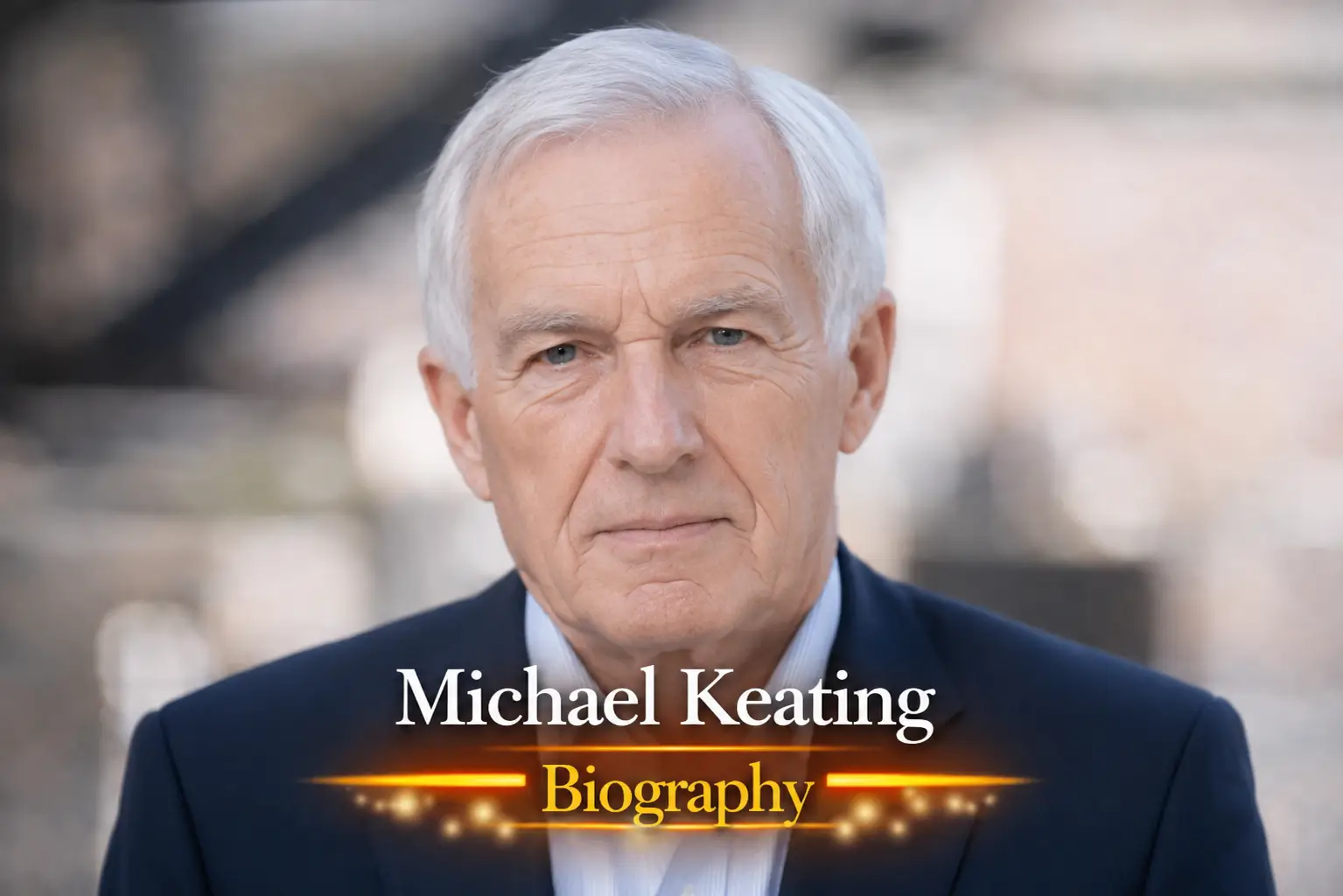
He never played the hero. He played the man who desperately didn’t want to be there — and that, paradoxically, is what made Michael Keating unforgettable. When the BBC’s cult science fiction series Blake’s 7 launched in January 1978, it needed a coward. What it got, in Keating’s hands, was something far richer: a fully human portrait of fear, warmth, and reluctant loyalty that outlasted every more heroic character on the show. This Michael Keating biography traces the arc of a career that spanned six decades — from a teenage debut at Nottingham Playhouse to the cobblestones of Walford, with stops at the National Theatre, the Old Vic, and the West End along the way. On 21 May 2026, the British entertainment world learned he had died at the age of 79. The tributes that followed were immediate, heartfelt, and telling.
Quick Facts
| Full Name | Michael Frank Keating |
| Born | 10 February 1947, Edmonton, Middlesex, England |
| Died | May 2026, age 79 |
| Nationality | British (English) |
| Profession | Actor (theatre, television, audio drama) |
| Known For | Vila Restal in Blake’s 7; Reverend George Stevens in EastEnders |
| Net Worth | Not publicly disclosed |
| Years Active | 1966–2026 |
Micheal Keating: Early Life & Background
Michael Frank Keating was born on 10 February 1947 in Edmonton, Middlesex — then a working-class corner of north London that was still rebuilding its identity in the post-war years. Edmonton in the late 1940s and 1950s was a community of factory workers, market traders, and tight terraces. It was not, by any conventional measure, a launching pad for a stage career. Yet Keating found his way to the theatre young — and once he arrived, he never truly left.
Little is publicly documented about his parents or siblings. What we know is the trajectory: a north London childhood that produced a performer of exceptional precision and instinctive warmth, one who would spend more than half a century making audiences care deeply about the characters he inhabited — regardless of whether those characters were heroes, villains, or something awkwardly in between.
Education and Early Training
Keating began his acting career in 1966, with his first professional role at Nottingham Playhouse under the artistic directorship of the classical actor John Neville. Neville was one of the most respected figures in British theatre at the time — a Shakespearean of genuine renown who had transformed Nottingham Playhouse into a regional powerhouse. For a young actor straight out of north London, landing a place there was no small thing.
His career began on stage at the age of 19, with his debut at Nottingham Playhouse leading to tours across British theatres. After two and a half years at Nottingham, he went on to perform in theatres across the United Kingdom, including the Library Theatre Manchester, the Pitlochry Theatre, the Lyceum Theatre Edinburgh and the Lyric Theatre Belfast, as well as numerous repertory and touring productions throughout England.
This was the classical repertory circuit — the training ground that shaped a generation of British actors. Night after night in different cities, playing different roles, learning to hold an audience with nothing but text and technique. It produced in Keating exactly the kind of actor that television would later rely on: someone who could find the truth in a character quickly, hold it, and make it look effortless.
Career Timeline: From Nottingham to the Stars
Television Breakthrough and the Road to Blake’s 7
Keating’s early television roles include Stephen Grigg in the environmental thriller series Doomwatch (1970) — a BBC drama that was, for its era, startlingly progressive in its subject matter, addressing industrial pollution and scientific ethics at a time when those weren’t fashionable concerns. It was the kind of show that attracted serious actors. Keating was in his early twenties and already earning screen credits.
Throughout the mid-1970s, he continued building his television presence. The pivotal step came in 1977. He gained further prominence with an appearance in Doctor Who, where he played Goudry in the 1977 serial “The Sun Makers.” Specifically, Keating appeared in four episodes of the Doctor Who serial “The Sun Makers” in 1977. It was a satirical story set on a dystopian Pluto governed by a tax-collecting corporation — rich, imaginative BBC science fiction at its best. And it placed Keating squarely in the orbit of BBC drama producers who were building something far larger.
Blake’s 7: 52 Episodes, One Irreplaceable Character
Just over a month after The Sun Makers, Keating first appeared in the role of Vila Restal in the BBC TV series Blake’s 7, which aired from 1978 to 1981. The show was created by Terry Nation — the man who had also created the Daleks — and pitched as a darker, morally ambiguous counterpoint to Star Trek. It followed a group of reluctant rebels fighting a totalitarian federation. Most of the crew were outlaws, criminals, and misfits. Vila Restal was arguably the most honest about it.
As Vila Restal in Blake’s 7, Michael appeared across all four series of the show, from 1978 to 1981 — the only cast member to appear in all 52 episodes. Vila was nominally the gang’s thief and self-declared coward, though Michael always preferred a more precise description: cautious, not cowardly. In his hands, Vila was something richer than comic relief. He was warm, wily, honest about his own limitations, and almost impossible not to love.
That distinction — the only actor to appear in every single episode — is not a minor footnote. Blake’s 7 rotated its cast, killed off major characters, and kept its audience perpetually off-balance. That Vila survived, and that audiences never tired of him, says everything about what Keating brought to the role. On his own website, Keating acknowledged the debt he owed to director David Maloney, noting that it was Maloney “who had the final say in the casting of myself as Vila in Blake’s 7, which has continued to be a part of my life even today.”
Blake’s 7 attracted around 9 million viewers at its peak — a remarkable figure for a BBC science fiction series. It ran for four series and ended with one of the most audacious finales in British TV history: a bloodbath in which almost every main character was killed. Keating’s Vila was among the last standing when the credits rolled.
Stage: National Theatre, Old Vic, and the West End
Television fame never pulled Keating away from the theatre. He later enjoyed extended engagements at prestigious venues including the National Theatre and the Old Vic. These were not vanity credits. The National Theatre and Old Vic represent the apex of British theatrical life — institutions with rigorous casting standards and technically demanding productions. Keating’s presence at both reflects the esteem in which he was held by the stage establishment.
In 1985, he created the role of Marty at the Phoenix Theatre in the West End in Are You Lonesome Tonight, Alan Bleasdale’s play about Elvis Presley, in which Martin Shaw played the King. Bleasdale was one of the most celebrated British dramatists of his generation — the writer of Boys from the Blackstuff, a defining cultural document of Thatcherite Britain. To create a role in a Bleasdale play, in the West End, alongside Martin Shaw, is a significant career moment by any measure.
The 1980s and 1990s: Breadth Over Headlines
In 1981, Keating appeared in an episode of the BBC sitcom Yes Minister titled “The Death List,” playing the role of Police Constable Ross. Yes Minister was one of the most critically acclaimed British comedies ever made, and also one of the most carefully written. Every line landed. Every role, however small, needed an actor who understood comic timing at a molecular level.
Some years later, Michael Keating reunited with his Blake’s 7 co-star Gareth Thomas in an episode of the BBC drama series Casualty. These weren’t the flashy high-profile roles. They were the workings of a professional actor — always employable, always credible, always doing the job properly.
This is what Bigfinish has to say about Michael Keating
Doctor Who Returns: Audio Adventures
In 2004, Keating returned to the Doctor Who franchise, guest starring as Major Koth in the Big Finish Productions audio adventure The Twilight Kingdom. In 2006, he starred in another Doctor Who audio adventure, this time as Inspector Chardalot in Year of the Pig. Big Finish Productions had by this point become a major cottage industry, producing professional-quality audio dramas with original BBC cast members. For fans, these releases were as canonical as the television show itself.
EastEnders: Twelve Years in Walford
Keating first appeared as Reverend Stevens in EastEnders on 10 January 2005, with his last appearance on 28 September 2017. His most sustained television presence came through EastEnders, where he portrayed Reverend George Stevens from 2005 to 2017, appearing in over 50 episodes in a recurring capacity. He brought a spiritual and pastoral dimension to the long-running soap.
Although Keating was never a permanent cast member in the soap, he continued to appear as the local vicar in EastEnders, usually for a single episode or a few episodes at a time, in connection with another character’s christening, marriage, or funeral, or relating to regular churchgoer Dot Branning (June Brown).
That relationship with June Brown’s Dot Cotton gave the Reverend Stevens role its emotional backbone. Dot was one of the soap’s most beloved characters — a devout Christian whose faith was tested endlessly by the chaos of Walford life. Stevens was her spiritual anchor. It was a role that required quiet authority and genuine warmth. Keating delivered both.
Micro Men and Later Career
In 2009, Keating had a brief role in the BBC one-off drama Micro Men about the rise of the British home computer market in the late 1970s and early 1980s. The drama starred Alexander Armstrong and Martin Freeman, and was a nostalgic, sharp-eyed account of a pivotal moment in British technological history. He also appeared in Midsomer Murders as Derek Painter in the 2009 episode “The Dogleg Murders.”
Throughout the 2010s, he continued reprising Vila Restal in an expanding universe of Big Finish audio productions. His voice credits included Blake’s 7: A Rebellion Reborn, Blake’s 7: The Liberator Chronicles, Blake’s 7: The Classic Adventures, Doctor Who: The Monthly Adventures, Doctor Who: The Fourth Doctor Adventures, and The Worlds of Blake’s 7.
Net Worth & Financials
Michael Keating’s net worth was never publicly disclosed, and no credible figure exists in the public domain. What can be said with confidence is that a career spanning six decades — across the National Theatre, the Old Vic, the West End, the BBC’s most-watched drama series, and a substantial audio drama portfolio — represents a lifetime of consistent, professional-grade employment in one of the most precarious industries in the world. He worked, consistently and well, from 1966 until his death in 2026. That is its own kind of financial testimony.
Personal Life & Relationships
Michael Keating was notably private about his personal life, and very little of it entered the public record. He was regarded by colleagues as a warm, generous collaborator — a description that recurs in virtually every tribute published following his death. Big Finish producer Peter Anghelides reflected on their collaboration, noting his delight at working with an actor he first encountered at BBC Television Centre in 1981, saying: “His cheery presence on studio days was always most welcome. I would sit at the back of the Audio Sorcery control room hooting with laughter at his comic timing in our recordings.”
That quality — the ability to make a room warm simply by being in it — surfaces repeatedly in accounts from those who worked alongside him. He appeared to be, by all available evidence, a man who took his craft seriously and his ego lightly. In an industry that produces its fair share of difficult personalities, that combination is rarer than it sounds.
Legacy & Impact
What Changed Because of Michael Keating?
The question worth asking of any actor’s legacy is not merely what they appeared in, but what they made possible — what they changed in the craft or the culture around them.
For Vila Restal, the answer is meaningful. British science fiction in 1978 had not yet learned how to write characters who were simultaneously funny, cowardly, and genuinely moving. The genre tended toward heroism or villainy, not the complicated middle ground. Keating’s Vila was someone who admitted his fear, who would rather run than fight, who complained constantly — and yet who, when it mattered, was still there. Fans described him as bringing “wonderful lightness, warmth, fear, drama and humour” to the character, calling Vila “integral to Blake’s 7.”
That template — the reluctant participant, deeply human in their frailty — became a staple of ensemble drama in the decades that followed. Whether or not later writers were consciously drawing on Vila Restal, Keating had demonstrated what the character type could achieve.
Science fiction enthusiasts will remember him best as Vila Restal, the reluctant criminal with exceptional lock-picking abilities whom he played throughout Blake’s 7‘s entire run. But it would be a mistake to reduce him to that. The man who spent two and a half years at Nottingham Playhouse under John Neville, who worked at the National Theatre and the Old Vic, who created a role in an Alan Bleasdale West End premiere, who gave twelve years to EastEnders — that man was a craftsman of the first order, and British television was richer for him.
His death marks the loss of one of British television’s most quietly formidable character actors.
FAQ Section
Q: What is Michael Keating best known for? Michael Keating is best known for playing Vila Restal in the BBC science fiction series Blake’s 7 (1978–1981) and Reverend George Stevens in EastEnders (2005–2017). He is the only actor to appear in all 52 episodes of Blake’s 7, making Vila one of the most sustained characters in the show’s history.
Q: When and where was Michael Keating born? Michael Frank Keating was born on 10 February 1947 in Edmonton, Middlesex, England. He began his professional acting career in 1966, aged 19, with his first role at Nottingham Playhouse.
Q: Did Michael Keating appear in Doctor Who? Yes. Keating appeared in four episodes of the Doctor Who serial “The Sun Makers” in 1977, playing a character called Goudry. He later reprised his connection to the franchise through several Big Finish audio adventures, including The Twilight Kingdom (2004) and Year of the Pig (2006).
Q: How many episodes of EastEnders did Michael Keating appear in? Keating appeared in 54 episodes of EastEnders in a recurring capacity, playing Reverend George Stevens from January 2005 to September 2017. His character was frequently associated with Dot Branning (June Brown) and appeared during major life events such as christenings, weddings, and funerals.
Q: When did Michael Keating die? Michael Keating died in May 2026 at the age of 79. No cause of death was publicly disclosed at the time of the initial announcements. Tributes immediately poured in from fans, colleagues, and institutions including Big Finish Productions, where he had continued working on audio dramas in recent years.
About This Article
This biography was written for general readers curious about Michael Keating’s life, career, and legacy — particularly those who know him from Blake’s 7, EastEnders, or Doctor Who and want a more complete picture. It was informed by Wikipedia’s documented filmography, official statements from Big Finish Productions (bigfinish.com), IMDB records, and breaking news coverage published on 21 May 2026 following the announcement of his death. Where specific facts could not be independently verified beyond a single source, this is noted.
RELATED ARTICLES:
- Megan Thee Stallion: Age, Height, Net Worth, Songs, Klay Thompson & Everything You Need to Know
- Gabrielle Carrington (RielleUK): Age, X Factor, Instagram, Blue Story & the Soho Crash Explained
- Klay Thompson: Age, Height, Net Worth, Wife, Megan Thee Stallion & Everything You Need to Know