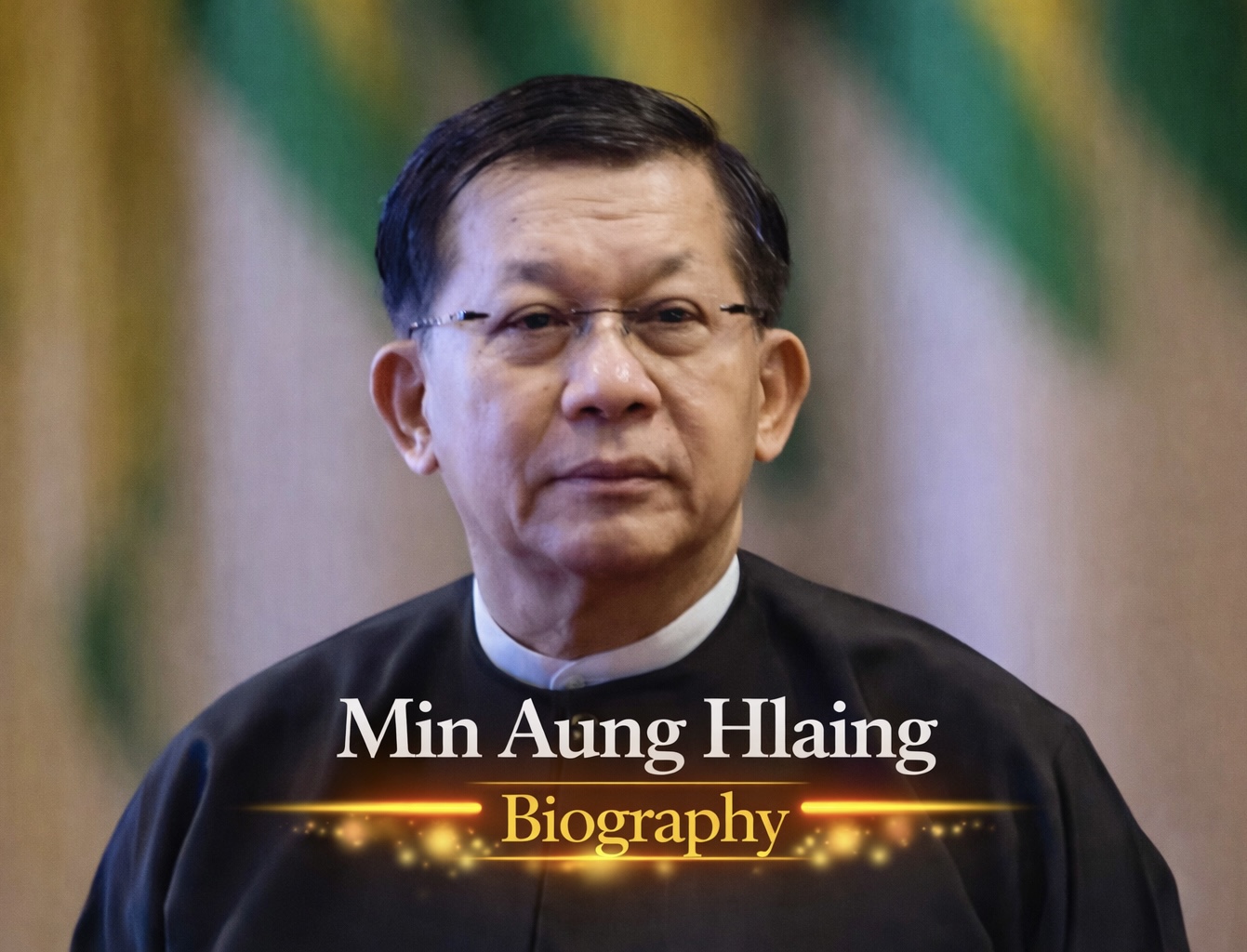
Who Is Min Aung Hlaing?
Min Aung Hlaing is a Burmese military general and politician who currently serves as the President of Myanmar (as of April 2026). Born on July 3, 1956, in Dawei, Myanmar, he rose through the ranks of the military to become one of the most powerful figures in the country. He previously held the position of Commander-in-Chief of the Myanmar Armed Forces (Tatmadaw) from 2011 until 2026, consolidating significant control over both the military and political landscape.
He is globally known for leading the 2021 military coup, which overthrew the elected government of Aung San Suu Kyi and plunged Myanmar into prolonged political instability and conflict. In 2026, he transitioned from military leadership into a formal political role, becoming president following a parliamentary vote dominated by military-backed representatives.
Min Aung Hlaing is currently trending due to his controversial rise to the presidency amid ongoing civil unrest, international criticism, and allegations of human rights abuses. A key highlight of his career is his long-standing dominance over Myanmar’s military and his central role in shaping the country’s modern political crisis, making him one of the most influential and contentious figures in Southeast Asia today.
Early Life and Background: Min Aung Hlaing Childhood, Family and Origins
Min Aung Hlaing was born on July 3, 1956, in Dawei (formerly Tavoy), Myanmar, a coastal city in the southern part of the country. He grew up in a modest household, with his father working as a civil engineer, which provided a stable but relatively ordinary upbringing.
During his early years, he lived through a period when Myanmar (then Burma) was under military-influenced governance, an environment that likely shaped his worldview from a young age. Although detailed accounts of his childhood are limited, it is known that he had a disciplined upbringing and developed an early interest in structure, authority, and national service.
After completing his basic education, he initially enrolled at Yangon University, where he studied law. However, his academic journey took a decisive turn when he chose to pursue a military career. His path into the armed forces was not immediate, as he reportedly faced multiple unsuccessful attempts before gaining admission.
In 1974, after persistence and determination, he was finally admitted into the Defense Services Academy, Myanmar’s premier military training institution. This marked the beginning of his transformation from a civilian student into a career military officer.
Overall, Min Aung Hlaing’s early life reflects a combination of discipline, persistence, and gradual alignment with military ideals, which laid the foundation for his rise to the highest levels of power in Myanmar.
Education: Min Aung Hlaing Academic Background and Military Training
Min Aung Hlaing’s educational journey reflects a transition from a conventional academic path to a structured military training background that ultimately defined his career.
He began his higher education at Yangon University, where he studied law. However, he did not complete his degree, as his interests gradually shifted toward a career in the military. His time at the university provided him with a basic understanding of legal and political systems, but it was not the defining phase of his professional development.
Determined to join the armed forces, he applied to the Defense Services Academy (DSA), Myanmar’s premier military institution. His entry into the academy was not immediate, as he reportedly faced multiple failed attempts before finally gaining admission in 1974.
At the Defense Services Academy, he underwent rigorous military training, which focused on leadership, discipline, strategy, and national defense. This period played a crucial role in shaping his mindset, leadership style, and future ambitions.
He successfully graduated in 1977, marking the official beginning of his military career. Unlike traditional academic paths, his education was heavily oriented toward military discipline, command structure, and strategic operations, which later became central to his rise within Myanmar’s armed forces.
Overall, Min Aung Hlaing’s education laid the foundation for his transformation into a career military officer, equipping him with the skills and discipline that propelled him to the highest levels of leadership in Myanmar.
Min Aung Hlaing Military Career
Early Military Service
Min Aung Hlaing began his military career after graduating from the Defense Services Academy in 1977, officially joining the Myanmar Armed Forces (Tatmadaw). His early years were spent in various regional postings, where he gained experience in field operations, counterinsurgency, and military administration.
During this period, he was involved in operations against ethnic armed groups, which have long been active in different parts of Myanmar. These early assignments helped him build a reputation as a disciplined and reliable officer, gradually earning the trust of senior commanders.
Rise Through the Ranks
Over the decades, Min Aung Hlaing steadily climbed the military hierarchy through a combination of experience, loyalty, and strategic positioning. His promotions reflected both his operational involvement and his growing influence within the military structure.
Key promotions include:
• Major General (around 2008–2009)
• Lieutenant General (2009)
• General (2011)
• Senior General (2013)
His rise coincided with a period of transition in Myanmar, where the military remained a dominant force despite political changes.
Command Roles and Influence
Before becoming the top military leader, he held several important command positions, including leadership roles in regional military commands. These roles placed him in charge of troops involved in security operations and internal conflicts, particularly in areas with ethnic insurgencies.
He became known for his strong command style and strict discipline, qualities that contributed to his growing authority within the Tatmadaw.
Commander-in-Chief of the Armed Forces (2011–2026)
In 2011, Min Aung Hlaing was appointed as the Commander-in-Chief of the Myanmar Armed Forces, the highest military position in the country. This marked a major turning point in his career, placing him at the center of both military and political power.
As Commander-in-Chief, he:
• Controlled the armed forces and key security institutions
• Oversaw military operations across the country
• Held constitutional authority over major ministries (Defense, Home Affairs, Border Affairs)
• Played a central role in national decision-making
Major Military Operations and Controversies
During his leadership, the military conducted several major operations, including actions against ethnic armed groups and the Rohingya population in Rakhine State. These operations drew global attention and criticism, with international organizations accusing the military of human rights violations and war crimes.
His role in these operations significantly shaped his global image as a highly controversial military leader.
Political Career: Min Aung Hlaing Rise to Power, 2021 Coup and Presidency
Min Aung Hlaing’s political influence began through his long-standing role in the Myanmar military (Tatmadaw), where the armed forces traditionally play a central role in governance. Although he did not start as a civilian politician, his position as a senior military officer gradually placed him at the heart of national decision-making.
His transition into direct political authority accelerated when he became the Commander-in-Chief of the Myanmar Armed Forces in 2011. In this role, he held significant constitutional power, as the military controls key ministries and retains influence over the government.
Over time, he became the most powerful figure in Myanmar, with authority extending beyond the military into political and administrative structures.
2021 Military Coup (Turning Point)
A defining moment in his political career came in February 2021, when he led a military coup that overthrew the democratically elected government led by Aung San Suu Kyi.
Following the coup:
• Declared a state of emergency
• Detained political leaders, including Aung San Suu Kyi
• Assumed control as Chairman of the State Administration Council (SAC)
This move marked the beginning of direct military rule, sparking nationwide protests, resistance movements, and international condemnation.
Consolidation of Power (2021–2025)
After the coup, Min Aung Hlaing worked to consolidate his control over Myanmar’s political system:
• Oversaw governance through the military-led administration
• Organized elections widely criticized as controlled and non-democratic
• Maintained strict control over opposition and dissent
• Faced ongoing internal conflict and civil war
Transition to Presidency In 2026
In April 2026, Min Aung Hlaing formally transitioned from military leadership into a civilian political role by becoming the President of Myanmar.
Key details:
• Elected through a military-dominated parliament
• Received 429 votes in the presidential selection
• Stepped down as Commander-in-Chief to assume the role
This move is widely seen as an attempt to legitimize military rule under a civilian framework, while still maintaining control over the country’s political system.
As President, he continues to:
• Lead Myanmar’s government amid ongoing instability
• Face international scrutiny and sanctions
• Oversee a country still experiencing civil conflict and political unrest
Min Aung Hlaing’s political career reflects a transition from military leadership to formal political authority, marked by the 2021 coup and his 2026 presidency. His rise to power has made him one of the most influential and controversial political figures in modern Myanmar history.
Personal Life: Min Aung Hlaing Family, Wife and Children
Min Aung Hlaing maintains a highly private and controlled personal life, with most publicly available information limited to basic family details and his public image as a military and political leader.
He is married to Kyu Kyu Hla, a retired lecturer, and their marriage has remained largely out of the public spotlight. The couple has two children: a son, Aung Pyae Sone, and a daughter, Khin Thiri Thet Mon. His children have occasionally been mentioned in reports, particularly in relation to business and public visibility, but detailed personal insights remain limited.
Despite his powerful public position, Min Aung Hlaing is known to keep his family life strictly private, rarely sharing personal moments or engaging in informal public interactions. His lifestyle reflects a disciplined and authoritative personality, consistent with his long military career.
He is often perceived as reserved, strategic, and firm in decision-making, with a leadership style shaped by years of military command. His public appearances are typically formal, reinforcing his image as a figure of authority rather than a relatable public personality.
Overall, Min Aung Hlaing’s personal life is characterized by privacy, discipline, and a strong separation between family and public duties, aligning with his identity as a career military leader turned political head of state.
Age, Religion, Tribe, Height & Physical Appearance
Min Aung Hlaing was born on July 3, 1956, which makes him 69 years old as of 2026. His age reflects decades of experience within Myanmar’s military and political system, having spent most of his life in positions of authority.
He is Burmese by nationality and belongs to the Bamar (Burman) ethnic group, the majority ethnic group in Myanmar, which has historically played a dominant role in the country’s political and military leadership.
In terms of religion, Min Aung Hlaing follows Theravāda Buddhism, the predominant religion in Myanmar. His public image often reflects strong alignment with Buddhist traditions, and he has been seen participating in religious ceremonies and supporting Buddhist institutions.
Physically, he has a stocky and solid build, consistent with his long military background. While his exact height is not officially documented, he appears to have an average height.
He is most commonly seen in military uniforms or formal state attire, often decorated with medals and insignia that reflect his high-ranking positions. His appearance typically conveys authority, discipline, and command, reinforced by his posture and formal presentation.
Overall, his physical presence and personal attributes contribute to an image defined by power, control, and traditional authority, aligning with his role as a long-serving military leader and current president of Myanmar.
Net Worth: Min Aung Hlaing Wealth, Assets and Financial Influence
Min Aung Hlaing’s exact personal net worth is not publicly disclosed, and there are no officially verified figures available in credible public financial records. Unlike leaders in transparent democratic systems, there is no requirement for him to publicly declare his assets, making it difficult to determine his precise financial standing.
Despite the lack of official figures, he is widely believed to be connected to significant wealth through his long-standing leadership within the Myanmar military. His influence is closely tied to powerful military-owned conglomerates such as Myanma Economic Holdings Limited (MEHL), which operates across key sectors including mining, telecommunications, banking, and tourism. Through these structures, he is seen as having substantial economic influence rather than a clearly defined personal fortune.
His family is also reported to have strong business interests. His son, Aung Pyae Sone, is known to own multiple companies and business ventures, while his daughter, Khin Thiri Thet Mon, is associated with a film production company. Reports suggest that family members have access to high-value investments, land deals, and corporate stakes, further reinforcing perceptions of significant wealth linked to his position.
In terms of assets, Min Aung Hlaing has been linked to high-value real estate, particularly in Yangon, although exact ownership details remain unclear. Watchdog organizations have also accused him of accumulating wealth through his political power and military role, though these claims are difficult to independently verify due to limited transparency.
Overall, his financial profile is considered opaque. The absence of public disclosures, combined with the military’s control over major parts of Myanmar’s economy, makes it challenging to separate personal wealth from institutional power. While his exact net worth remains unknown, he is widely associated with considerable economic influence shaped by his authority and connections rather than publicly documented assets.
Legacy: Min Aung Hlaing Impact In His Country
Min Aung Hlaing’s legacy is one of the most controversial and consequential in modern Myanmar history, defined by his central role in reshaping the country’s political trajectory through military dominance and authoritarian governance. As a long-serving military leader who later became president, he has had a profound impact on Myanmar’s institutions, governance structure, and international standing.
One of the defining elements of his legacy is the 2021 military coup, which ended a decade of partial democratic transition and returned the country to full military rule. This action triggered widespread protests, civil resistance, and an ongoing internal conflict that continues to shape Myanmar’s social and political landscape. His leadership has been associated with strict control over dissent, suppression of opposition, and prolonged instability, making him a highly polarizing figure both domestically and globally.
At the same time, he is seen by supporters within the military establishment as a leader who has preserved military authority and national control, maintaining the traditional dominance of the armed forces in Myanmar’s governance. His transition to the presidency in 2026 further solidified his influence, marking a shift from direct military rule to a more formal political structure while retaining power.
Overall, Min Aung Hlaing’s legacy is defined by power, control, and controversy, leaving a lasting imprint on Myanmar’s political system. He will be remembered as a leader who significantly altered the country’s democratic path, with long-term consequences that will continue to shape Myanmar’s future for years to come.
Conclusion
Min Aung Hlaing’s life and career reflect the rise of a military officer who became one of the most powerful and controversial figures in Myanmar’s modern history. From his early days in the armed forces to leading the 2021 military coup and eventually becoming president in 2026, his influence has shaped the country’s political direction in profound ways. While his leadership has solidified military control over the state, it has also brought significant internal conflict and international criticism. His legacy remains deeply divisive, representing both authority and instability, and his impact on Myanmar’s future will continue to be felt for years to come.
Frequently Asked Questions (FAQ) About Min Aung Hlaing
1. Who is Min Aung Hlaing?
Min Aung Hlaing is a Burmese military general and politician who serves as the President of Myanmar as of 2026.
2. How old is Min Aung Hlaing?
He is 69 years old as of 2026.
3. Where is Min Aung Hlaing from?
He was born in Dawei (Tavoy), Myanmar.
4. What is Min Aung Hlaing known for?
He is known for leading the 2021 military coup in Myanmar and later becoming president in 2026.
5. What was Min Aung Hlaing’s role before becoming president?
He served as the Commander-in-Chief of the Myanmar Armed Forces from 2011 to 2026.
6. Why is Min Aung Hlaing controversial?
He is widely criticized for alleged human rights abuses, the military coup, and suppressing democratic governance.
7. Is Min Aung Hlaing married?
Yes, he is married to Kyu Kyu Hla.
8. Does Min Aung Hlaing have children?
Yes, he has two children: Aung Pyae Sone and Khin Thiri Thet Mon.
9. What religion does Min Aung Hlaing follow?
He follows Theravāda Buddhism.
Read more:
- Sanjita Mohapatra IAS Biography: Age, UPSC Rank, Husband, Career, Education, Net Worth & Legacy
- Khushbaz Singh Jattana Biography: Age, Death, Accident, Net Worth, Family, Political Career & Legacy