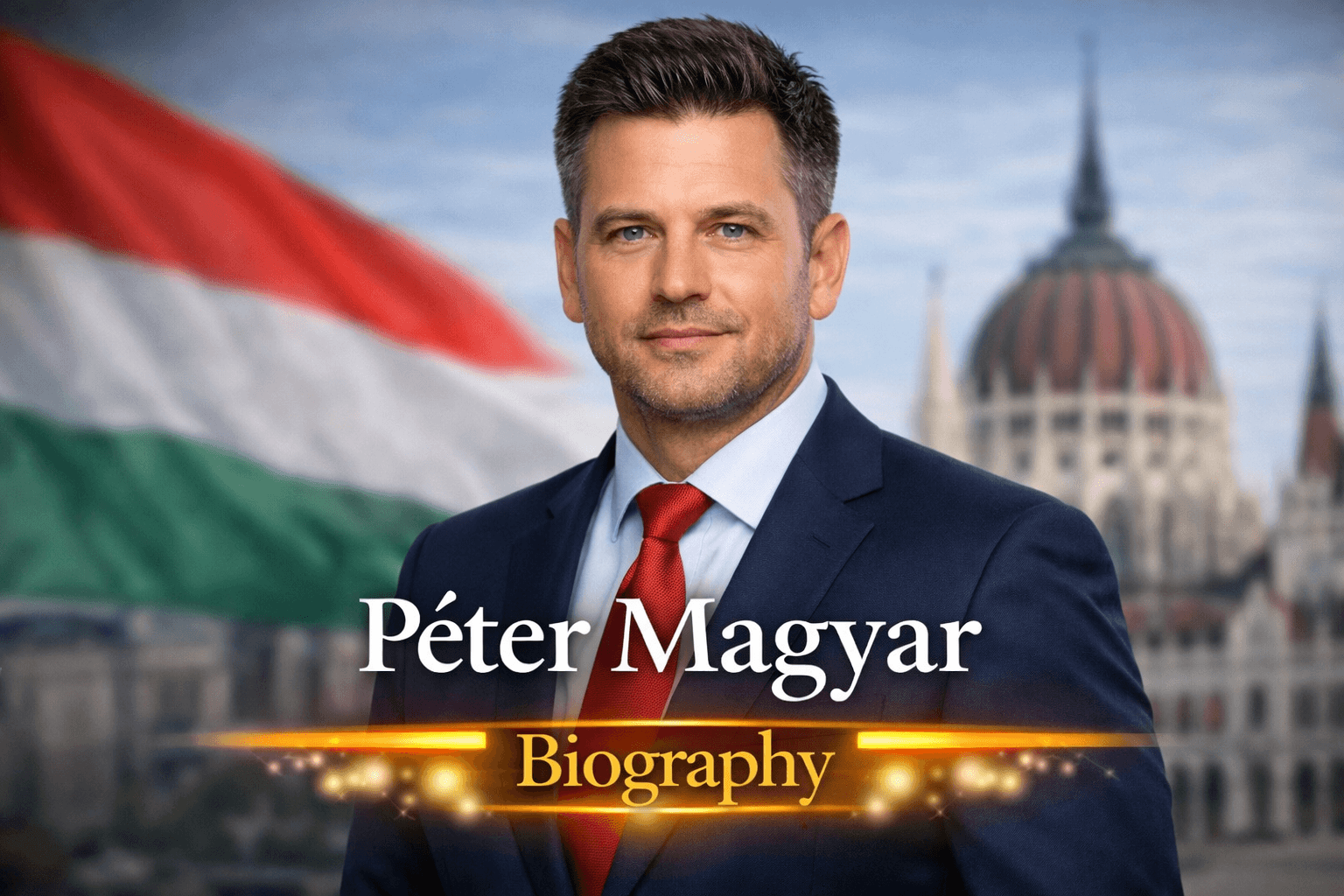
Who is Péter Magyar?
Péter Magyar is a Hungarian politician, lawyer, and former government insider who has become one of the most influential emerging figures in Hungary’s political space as of 2026. Born on 16 March 1981 in Budapest, he gained national prominence after breaking away from Fidesz, the ruling party led by Viktor Orbán, where he had been aligned for over two decades. His shift from insider to critic has given his public statements unusual credibility within Hungarian politics.
He is currently affiliated with the Tisza Party, a political movement formed in 2024, which represents a break from traditional power structures. His rise is closely linked to a combination of political exposure, personal controversy, and public dissatisfaction with centralized governance. As a result, his name has become highly searchable across news and political platforms in 2026. His growing influence reflects both his background and the evolving political climate in Hungary.
Early Life and Background
Péter Magyar was born on 16 March 1981 in Budapest, Hungary, placing him within the country’s administrative and political center from birth. Growing up in the capital provided him with direct exposure to the institutions that shape national policy and governance. This environment differs significantly from rural or less politically connected regions, where access to such structures is limited. His early years coincided with Hungary’s post-communist transformation, a period that redefined the country’s political identity. These circumstances played a role in shaping his awareness of governance systems.
He comes from a family with notable connections to Hungary’s intellectual and political elite, including his relation to Ferenc Mádl, who served as President of Hungary. This background placed him within a lineage that has historically engaged with public service and national leadership. Such proximity to authority likely influenced his perception of institutional responsibility and political structure. It also meant that his exposure to governance was not abstract but grounded in real-world observation. This foundation distinguishes him from many individuals who enter politics later in life.
His upbringing combined both cultural awareness and institutional familiarity, creating a balanced perspective on society and governance. The social environment of Budapest exposed him to diverse viewpoints, while his family background reinforced traditional structures of authority. Over time, these influences contributed to his decision to pursue a career in law and public service. His early life therefore reflects a convergence of opportunity, influence, and expectation. This combination would later shape his trajectory into national relevance.
Education
Péter Magyar pursued his higher education at Pázmány Péter Catholic University, where he earned a Juris Doctor (JD). This institution is recognized for its strong emphasis on legal theory, constitutional law, and governance systems. His academic training provided him with a structured understanding of how legal frameworks operate within a state. This foundation would later inform his ability to analyze and critique institutional processes. His education is a key component of his credibility as a public figure.
During his studies, Magyar developed analytical skills that allowed him to interpret complex legal and administrative structures. Legal education in Hungary often emphasizes both theoretical knowledge and practical application, preparing students for roles within government and public service. This dual approach enabled him to understand not only what laws exist but how they function in practice. His academic environment also exposed him to broader European legal systems, offering comparative perspectives. These insights contributed to his evolving understanding of governance.
Beyond formal education, his training influenced his communication style and public engagement. He approaches political issues with a focus on structure and procedure rather than emotional rhetoric. This method has allowed him to present arguments that are both accessible and grounded in expertise. His education therefore extends beyond credentials, shaping how he interacts with public discourse. It remains a defining aspect of his professional identity.
FURTHER READING ON PETER MAGYAR BIOGRAPHY
Career
Péter Magyar’s career began within the legal and administrative sectors, where he worked in roles connected to government institutions and public service. His early professional path aligned with his legal education, focusing on regulatory systems and institutional processes. These roles required a detailed understanding of governance, decision-making, and administrative structure. Through this experience, he gained firsthand insight into how policies are developed and implemented. This exposure formed the basis of his later public influence.
A significant portion of his career was defined by his long association with Fidesz, which lasted from 2002 to 2024. During this period, he operated within a political environment dominated by centralized leadership under Viktor Orbán. His involvement allowed him to observe the evolution of governance structures over time. This insider perspective provided him with a detailed understanding of both strengths and limitations within the system. It also positioned him uniquely when he later chose to speak out.
In 2024, Magyar made a decisive shift by breaking away from Fidesz and aligning with the Tisza Party. This transition marked a turning point in his career, transforming him from a participant in the system to one of its most visible critics. His public statements following this shift attracted significant attention. They highlighted issues related to transparency, accountability, and institutional reform. His career trajectory reflects a progression from internal involvement to external influence.
Major Activities and Political Influence
Péter Magyar’s influence is rooted not in traditional political campaigns but in his ability to articulate systemic issues from an insider perspective. His activities have focused on public engagement, media appearances, and political commentary rather than formal legislative roles. This approach allows him to operate outside conventional political frameworks while still shaping public discourse. His influence is therefore based on narrative and credibility rather than institutional authority. This distinction has contributed to his rapid rise.
His alignment with the Tisza Party reflects an attempt to channel public sentiment into a structured political movement. The party positions itself as an alternative to established power structures, emphasizing reform and accountability. Magyar’s role within this context is to provide both visibility and credibility. His background allows him to connect with audiences who may be skeptical of traditional opposition figures. This dynamic has expanded his reach across different segments of society.
The scale of his influence continues to grow as public engagement increases. His ability to communicate complex institutional issues in accessible terms has broadened his appeal. This has resulted in increased media coverage and public discussion surrounding his ideas. His activities are therefore not confined to formal political structures but extend into broader societal discourse. This expansion of influence is a key factor in his current relevance.
Breaking Point and Political Controversy
The turning point in Péter Magyar’s public profile occurred in 2024, following a series of events connected to his personal and political life. His separation from Judit Varga, who had served as Hungary’s Minister of Justice, brought him into the public spotlight. What began as a personal matter quickly evolved into a broader political discussion. Magyar used this moment to address systemic issues within Hungary’s governance. This shift transformed a private event into a national political moment.
His statements following this period focused on internal processes and institutional behavior. These comments attracted significant attention due to his insider status. They provided a perspective that was previously inaccessible to the general public. This increased scrutiny placed both him and the system under examination. The situation marked a transition from private individual to public figure.
The controversy also highlighted the risks associated with breaking from established structures. His decision to speak out carried both personal and professional consequences. However, it also established his credibility as a reform advocate. This balance between risk and influence defines his role in the current political landscape. The breaking point therefore serves as a critical moment in his biography.
Current Trending News (2026)
As of 2026, Péter Magyar remains a trending figure due to his continued involvement in political discourse and his challenge to established power structures. His emergence has coincided with increased public attention on governance and accountability in Hungary. This alignment has sustained his relevance beyond initial headlines. Media coverage continues to highlight his statements and activities. His presence remains consistent within national discussions.
His association with the Tisza Party has further strengthened his position as a reform-oriented figure. The party’s growing visibility reflects broader public interest in alternative political movements. Magyar’s role within this context is both symbolic and functional. He represents a shift in how political influence can be generated. This development has contributed to his ongoing prominence.
Public reaction to his rise has been mixed, reflecting the complexity of his position. Supporters view him as a credible advocate for change, while critics question his motivations and timing. This range of responses highlights the impact of his actions. It also ensures that he remains a subject of discussion. His trending status is therefore sustained by both support and controversy.
Personal Life
Péter Magyar was married to Judit Varga from 2006 until their divorce in 2023. Their relationship placed him within the inner circle of Hungary’s political environment. This proximity provided him with direct exposure to high-level decision-making. It also contributed to his understanding of institutional dynamics. His personal life is therefore closely linked to his professional trajectory.
The couple has three children, and despite his public profile, Magyar has maintained a level of privacy regarding his family. This approach reflects a deliberate effort to separate personal life from political activity. It also reinforces his image as a disciplined and focused individual. His role as a father adds a personal dimension to his public identity. This balance between visibility and privacy is notable.
Following his divorce, Magyar managed to redirect attention toward broader political issues. This strategic shift allowed him to maintain credibility and focus. His ability to navigate personal challenges while remaining publicly engaged demonstrates resilience. His personal life therefore contributes to his overall narrative. It provides context without overshadowing his public role.
Social Media Presence
Péter Magyar’s presence on digital platforms has contributed to his growing influence. While specific platform activity may vary, his engagement with media channels has amplified his reach. Public figures in similar positions often use social media to communicate directly with audiences. This approach allows for immediate dissemination of ideas and responses. Magyar’s visibility has benefited from this dynamic.
His communication style reflects a balance between professional tone and accessibility. This has enabled him to connect with a broader audience beyond traditional political circles. Digital engagement also plays a role in shaping public perception. It allows individuals to present narratives without relying solely on traditional media. This factor has supported his rise in visibility.
The influence of social media in his case is not limited to self-promotion but extends to public discussion. His statements often generate responses and debates across platforms. This interaction contributes to his relevance within ongoing conversations. It also reflects the changing nature of political communication. His presence in this space is therefore significant.
Age, Ethnicity, Religion, Physical Appearance
Péter Magyar was born on 16 March 1981, making him 45 years old as of 2026. His age places him within a generation that combines professional experience with contemporary political awareness. This positioning allows him to engage with both traditional and modern perspectives. His background reflects Hungary’s cultural and historical context. This combination contributes to his public identity.
He is Hungarian by nationality, with a background rooted in the country’s cultural and intellectual traditions. There is no widely confirmed public record detailing his specific religious affiliation. However, his public image aligns with values commonly associated with European conservative frameworks. This aspect of his identity is presented cautiously due to limited verified information. His ethnicity and nationality remain central to his profile.
In terms of physical appearance, Magyar is generally described as having a professional and composed presence. His public image reflects discipline and confidence, consistent with his background in law and administration. While specific details such as height are not widely documented, his appearance aligns with expectations of public office. This contributes to his overall perception. His physical presentation reinforces his authority.
Legacy and Impact
Péter Magyar’s impact is still developing, but it is already shaping political discourse in Hungary. His transition from insider to critic has introduced new dynamics into an otherwise stable system. This shift highlights the potential for change within established structures. His influence extends beyond individual actions to broader societal implications. This makes his role significant.
Public perception of Magyar varies, reflecting differing views on his actions and motivations. Supporters see him as a credible advocate for transparency and reform. Critics question the timing and implications of his shift. This diversity of opinion underscores his impact on national conversation. It also ensures continued relevance.
His legacy will likely be defined by his ability to translate influence into structured outcomes. Whether through formal political roles or continued public engagement, his presence has already altered discourse. This change reflects broader shifts in expectations of governance. His impact therefore extends beyond immediate events. It represents a longer-term evolution.
Conclusion
Péter Magyar’s biography reflects a transition from institutional insider to influential public figure. His background in law and governance has provided him with the tools to engage with complex systems. His rise highlights broader changes within Hungary’s political environment. By combining experience with strategic communication, he has established a strong presence. His influence continues to evolve.
His story illustrates how individuals can reshape narratives from within established systems. This dynamic challenges traditional pathways to political influence. It also raises questions about the future of governance and accountability. His role remains central to these discussions. His biography is therefore both current and ongoing.
Frequently Asked Questions (FAQ) About Péter Magyar
- Who is Péter Magyar?
Péter Magyar is a Hungarian lawyer, diplomat, and politician known for breaking away from Fidesz and becoming a reform-focused public figure. - How old is Péter Magyar?
He is 45 years old as of 2026. - Where is Péter Magyar from?
He is from Budapest, Hungary. - What is his profession?
Lawyer, diplomat, and politician. - What party does he belong to?
He belongs to the Tisza Party. - Was he part of Fidesz?
Yes, he was part of Fidesz from 2002 to 2024. - Is Péter Magyar married?
He was married to Judit Varga from 2006 to 2023. - How many children does he have?
He has three children. - Why is Péter Magyar trending?
He is trending for breaking away from Fidesz and publicly criticizing the system led by Viktor Orbán.
READ MORE:
- Nicholas Leslie Smith Biography: Age, Career, Death, and Football Legacy
- Who Is Robert J. Hall? Boston Marathon Pioneer & Wheelchair Racing Legend (2026)