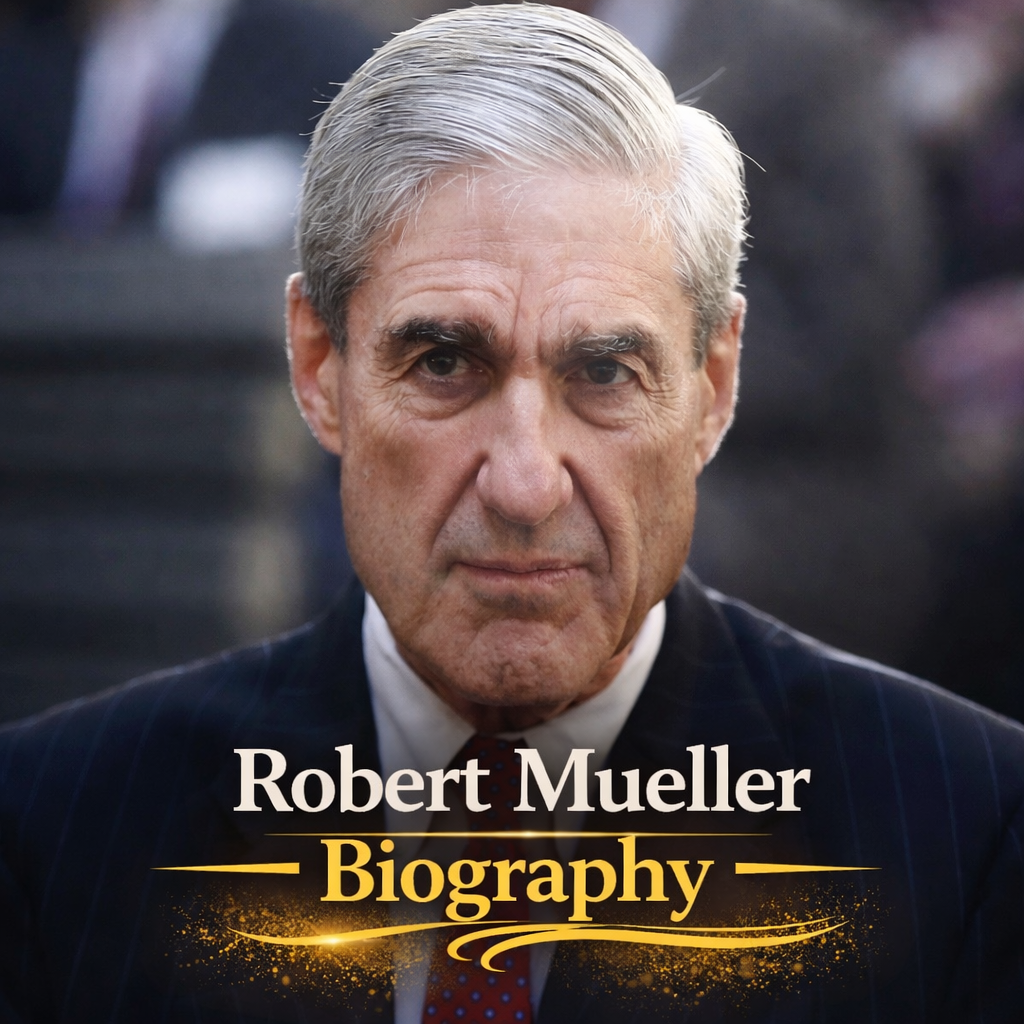
Who Is Robert Mueller ?
Robert Swan Mueller III is an American lawyer and government official known for his long career in law enforcement and national security. He served as the Director of the Federal Bureau of Investigation from 2001 to 2013, making him one of the longest-serving leaders in the agency’s history. Mueller is widely recognized for his disciplined leadership, his military service during the Vietnam War, and his reputation for integrity in public service.
He rose to global prominence when he was appointed Special Counsel to lead the Russia investigation into interference in the 2016 U.S. presidential election. His investigation confirmed that Russia interfered in the election process and examined connections between Russian operatives and associates of Donald Trump. Although the report did not establish a criminal conspiracy, it became one of the most consequential political investigations in modern American history.
A key highlight of Mueller’s career was his leadership of the FBI during and after the September 11 attacks, where he helped transform the bureau’s focus toward counterterrorism and national security. He continues to be a significant figure in discussions about law enforcement independence and accountability, and he trends in public discourse whenever debates arise about political investigations, justice system integrity, and U.S. election security.
Robert Mueller Early Life and Background
Robert Swan Mueller III was born on August 7, 1944, in New York City, into a well-established and disciplined American family. He grew up in an environment that valued education, responsibility, and public service. His father, Robert Mueller Jr., worked as an executive and had a strong influence on his son’s sense of duty and structure, while his mother, Alice Truesdale Mueller, supported a stable and academically focused household.
Mueller spent much of his childhood in a traditional upbringing marked by structure and achievement. He attended the prestigious St. Paul’s School, where he developed a strong sense of discipline and leadership. During his school years, he showed early interest in sports, particularly lacrosse, and academics, demonstrating a balanced personality that combined physical activity with intellectual growth.
From a young age, Mueller displayed a deep sense of patriotism and commitment to service. His early experiences, including exposure to structured education and competitive environments, helped shape his character. These formative years played a crucial role in guiding him toward higher education at Princeton University and eventually a lifelong career in law enforcement, military service, and national leadership.
Robert Mueller Education
Robert Swan Mueller III built a strong academic foundation through some of the most respected institutions in the United States, preparing him for a career in law, military service, and national security.
He attended St. Paul’s School for his secondary education, where he developed discipline, leadership skills, and a competitive spirit through both academics and athletics. After graduating, he enrolled at Princeton University, where he earned a Bachelor of Arts degree. His time at Princeton played a major role in shaping his worldview and commitment to service.
Following his undergraduate studies, Mueller pursued further academic training at New York University, where he obtained a Master’s degree in International Relations. This advanced study gave him deeper insight into global politics and security, which later proved valuable in his government roles.
He then attended the University of Virginia School of Law, earning his Juris Doctor (JD) degree. His legal education provided the technical expertise and analytical skills required for his future work as a prosecutor and federal official.
In addition to formal education, Mueller received military training through the United States Marine Corps, which further strengthened his leadership, discipline, and decision-making abilities. This combination of elite academic training and military preparation laid the groundwork for his early career in law enforcement and public service.
Robert Mueller Military Career
Robert Swan Mueller III began his military career out of a strong sense of duty and patriotism during a turbulent period in American history. After completing his early university education, he chose to join the United States Marine Corps, committing himself to active service at a time when the Vietnam War was ongoing.
He underwent rigorous officer training and was commissioned as a Marine Corps officer, quickly taking on leadership responsibilities. Early in his military career, Mueller was deployed to Vietnam, where he led infantry troops in combat operations. His role required courage, quick decision-making, and strong leadership under extreme conditions, all of which became defining traits of his professional life.
During his service, Mueller achieved significant recognition for bravery and performance in combat. He was awarded the Bronze Star, the Purple Heart, and several other commendations for his actions in the field. These honors reflected both his personal courage and his ability to lead effectively in high-risk situations.
Although he did not pursue a long-term military career, his time in the Marines marked a critical phase of personal and professional development. He left active service with a reputation for discipline and resilience, qualities that later shaped his rise in law enforcement and government service. While his current role is outside the military, the values and experiences gained during his service remained central to his leadership style throughout his career.
Robert Mueller Legal and Government Career
Robert Swan Mueller III entered the legal profession after earning his law degree from the University of Virginia School of Law. He began his career in private legal practice but soon transitioned into public service, driven by a strong commitment to justice and national duty. His early move into government work marked the beginning of a long and influential career in federal law enforcement.
Mueller quickly rose through the ranks as a federal prosecutor, taking on complex criminal cases and building a reputation for precision and discipline. He served as a U.S. Attorney and held several senior positions within the United States Department of Justice. During this period, he handled major investigations involving organized crime, terrorism, and corporate fraud, establishing himself as a trusted and capable legal authority.
His most significant career milestone came in 2001 when he was appointed Director of the Federal Bureau of Investigation by President George W. Bush. Just days after taking office, the September 11 attacks reshaped his role, and he led the FBI through a major transformation focused on counterterrorism and national security. His leadership during this period earned him widespread recognition, and his tenure was later extended by President Barack Obama, highlighting bipartisan trust in his leadership.
After completing his 12-year tenure at the FBI, Mueller returned briefly to private practice before being called back into public service in 2017. He was appointed Special Counsel to oversee the Russia investigation, one of the most high-profile political investigations in U.S. history, involving the 2016 presidential election and connections to Donald Trump’s campaign. The investigation became a defining moment of his career and reinforced his reputation for independence and integrity.
In his current role, Mueller remains largely retired from active government service but continues to be regarded as a leading figure in American law enforcement history. His career progression reflects decades of steady advancement, professional excellence, and national impact.
Robert Mueller Career as FBI Director (2001–2013)
Robert Swan Mueller III entered the role of Director of the Federal Bureau of Investigation in 2001 after a long and respected career as a federal prosecutor and senior official within the United States Department of Justice. He was appointed by President George W. Bush, marking a major step in his professional journey and placing him at the helm of one of the world’s most powerful law enforcement agencies.
Just one week after taking office, the September 11 attacks dramatically reshaped his responsibilities. One of his earliest milestones as director was leading the FBI through an urgent transformation from a traditional crime-focused agency into a counterterrorism and intelligence-driven organization. He oversaw structural reforms, strengthened intelligence gathering, and improved coordination with other national and international security agencies.
During his 12-year tenure, Mueller achieved several major milestones. He modernized the FBI’s operations, enhanced its technological capabilities, and expanded its role in preventing terrorist threats. Under his leadership, the bureau handled high-profile investigations related to national security, cybercrime, and organized crime. His steady leadership during a period of global uncertainty earned him widespread respect across political lines.
Mueller’s performance and credibility led to rare recognition when President Barack Obama requested that he remain in office beyond the standard 10-year term, extending his service to 12 years. This extension reflected strong bipartisan confidence in his leadership and the importance of continuity during a sensitive period.
By the time he stepped down in 2013, Mueller had firmly established himself as one of the most influential FBI directors in history. Although he later returned to public service as Special Counsel, his role as FBI Director remains a defining chapter of his career, showcasing his ability to lead through crisis, reform institutions, and uphold the integrity of federal law enforcement.
Special Counsel Investigation (2017–2019)
Robert Swan Mueller III returned to public service in 2017 when he was appointed Special Counsel by the United States Department of Justice. His task was to lead an independent investigation into Russian interference in the 2016 U.S. presidential election, a politically sensitive issue involving the campaign of Donald Trump. The investigation was designed to determine whether any coordination existed between Russian operatives and individuals linked to the campaign, as well as to assess any potential obstruction of justice.
Over the course of nearly two years, Mueller’s team conducted an extensive inquiry, issuing indictments, interviewing witnesses, and reviewing large volumes of intelligence and communications. The investigation confirmed that Russia carried out a coordinated effort to influence the election through hacking and disinformation campaigns. It also documented numerous contacts between Russian individuals and Trump campaign associates, though these interactions did not meet the legal threshold required to establish a criminal conspiracy.
The final report, released in 2019, presented a nuanced conclusion. It stated that while there was insufficient evidence to charge a conspiracy, the issue of obstruction of justice was more complex. Mueller did not make a definitive prosecutorial judgment on obstruction but explicitly noted that the evidence did not exonerate the president. This careful and measured outcome reinforced Mueller’s reputation for legal precision and independence, while also sparking widespread political debate and public discussion.
Robert Mueller Personal Life
Robert Swan Mueller III is known for maintaining a very private and disciplined personal life, reflecting the same values that defined his professional career. He is married to Ann Cabell Standish, and their long-standing marriage has been marked by stability and discretion. Despite his high-profile roles, Mueller has consistently kept his family life away from public attention, choosing to focus on duty rather than personal publicity.
He and his wife have two daughters, and he is regarded as a devoted family man. His lifestyle is simple and structured, shaped by his military background and years in government service. Mueller is not known for extravagance or public displays, instead preferring a quiet and reserved way of living that aligns with his reputation for humility and discipline.
In terms of personality, Mueller is widely described as calm, focused, and highly principled. He is known for being serious, methodical, and deeply committed to integrity. While he keeps his hobbies largely private, he has shown interest in sports and physical fitness since his younger years, particularly during his time playing lacrosse. Overall, his personal life reflects a man of strong character, consistency, and dedication to both family and service.
Robert Mueller Death and Tributes
Robert Swan Mueller III passed away on March 20, 2026, at the age of 81, marking the end of a long and distinguished career in American law enforcement and public service. In his later years, he faced health challenges, including complications associated with Parkinson’s disease, which gradually affected his condition. He died surrounded by family, leaving behind his wife, Ann Cabell Standish, and their two daughters.
Following his death, tributes poured in from across the United States and beyond, reflecting the deep respect he earned over decades of service. Political leaders, legal professionals, and former colleagues praised his integrity, discipline, and unwavering commitment to the rule of law. Many highlighted his leadership of the Federal Bureau of Investigation during the aftermath of the September 11 attacks, as well as his role in leading the Russia investigation, describing him as a symbol of professionalism and accountability.
At the same time, reactions to his death were not entirely uniform. While the majority of responses honored his legacy, some political commentary—particularly from Donald Trump—sparked public criticism and debate. Despite these contrasting reactions, the dominant narrative surrounding Mueller’s passing remains one of respect and recognition for a man whose career helped shape modern American law enforcement and reinforced the importance of institutional integrity.
Legacy
Robert Swan Mueller III is widely regarded as one of the most influential figures in modern American law enforcement. His legacy is defined by his steady leadership during times of national crisis and his ability to uphold institutional integrity under intense political pressure. As Director of the Federal Bureau of Investigation, he reshaped the bureau’s mission following the September 11 attacks, transforming it into a more intelligence-driven agency focused on counterterrorism and national security.
Beyond his tenure at the FBI, Mueller’s role as Special Counsel in the Russia investigation further cemented his place in history. He handled one of the most politically sensitive investigations in the United States with a measured and methodical approach, reinforcing public expectations around accountability and the rule of law. His refusal to be influenced by political pressures strengthened his reputation as a symbol of independence and professionalism.
In the long term, Mueller’s impact extends beyond specific cases or positions. He set a standard for leadership rooted in discipline, integrity, and public service. His career continues to influence how law enforcement agencies operate and how major investigations are conducted, particularly in areas involving national security and political accountability. Today, he is remembered as a figure who prioritized duty over recognition and helped shape modern expectations of justice and institutional trust.
FAQ About Robert Mueller
1. Who is Robert Mueller?
Robert Swan Mueller III is an American lawyer and government official best known for serving as Director of the Federal Bureau of Investigation and later as Special Counsel in the Russia investigation.
2. When was Robert Mueller born?
He was born on August 7, 1944, in New York City.
3. What is Robert Mueller famous for?
He is famous for leading the FBI during and after the September 11 attacks and for heading the Russia investigation into the 2016 U.S. election.
4. How long did Robert Mueller serve as FBI Director?
He served as FBI Director from 2001 to 2013, completing a 12-year tenure.
5. Did Robert Mueller serve in the military?
Yes. He served in the United States Marine Corps during the Vietnam War and received honors such as the Bronze Star and Purple Heart.
6. What were the findings of the Mueller Report?
The report confirmed that Russia interfered in the 2016 election but did not establish a criminal conspiracy with Donald Trump’s campaign. It also did not fully clear him on obstruction of justice.
7. Is Robert Mueller still active in government?
No. He is largely retired from public service and maintains a low profile.
8. What is Robert Mueller known for personally?
He is known for being disciplined, private, and highly principled, with a strong commitment to duty and integrity.
Read more:
- Rex Culpepper Biography: Accident, Age, Career, Cancer Story, Death, Family, and Legacy
- Bella Hadid Biography: Age, Height, Career, Net Worth, Relationships, Business Ventures, and Legacy